
Astronomy Picture of the Day


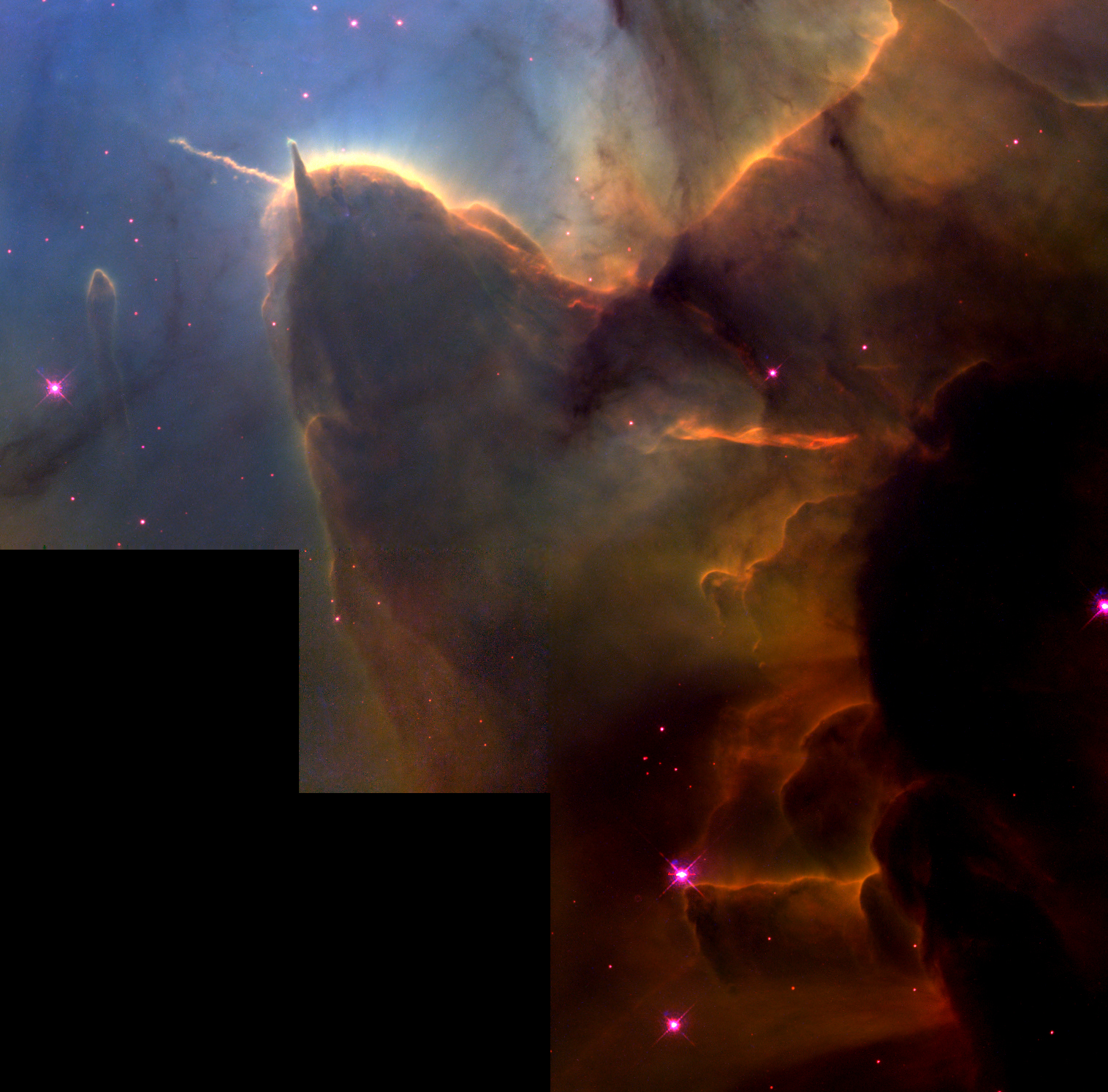
Explanation: Dust pillars are like interstellar mountains. They survive because they are more dense than their surroundings, but they are being slowly eroded away by a hostile environment. Visible in the above picture is the end of a huge gas and dust pillar in the Trifid Nebula, punctuated by a smaller pillar pointing up and an unusual jet pointing to the left. The pink dots are newly formed low-mass stars. A star near the small pillar's end is slowly being stripped of its accreting gas by radiation from a tremendously brighter star situated off the above picture to the upper right. The jet extends nearly a light-year and would not be visible without external illumination. As gas and dust evaporate from the pillars, the hidden stellar source of this jet will likely be uncovered, possibly over the next 20,000 years.
 Two galaxies perform an intricate dance in this new Hubble Space Telescope image. The galaxies, containing a vast number of stars, swing past each other in a graceful performance choreographed by gravity. CLick on image for larger view.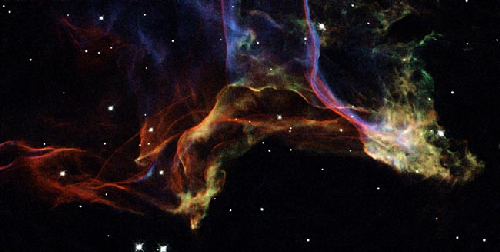
The Hubble Space Telescope has caught just-released snapshots of the 1500-light-year-distant Veil Nebula, the remnants of a supernova, or star explosion, that happened a few as five thousand years ago.
The Hubble close-ups reveal the rope-like filaments of gas in the nebula, which resulted from enormous amounts of dusty debris plowing into gaseous surroundings. Thicker filaments of material result from viewing the supernova’s shock wave edge-on, while more wispy and diffuse views correspond to a face-on view of other parts of the shock wave from Earth.
 Planets may be present in a quadruple star system 150 light years from Earth, according to Spitzer Space Telescope observations.
Today scientists announced that they had mapped a ring of dark matter around a galaxy cluster utilizing gravitational distortions observed in photographs taken by the Hubble space telescope.
This is a groundbreaking discovery, since for decades scientists had theorized that the bulk of the Universe is held together by dark matter, and that this matter could not be observed since it neither emits nor reflects light.
Read more at the Bad Astronomy Blog.

Explanation: The bright clusters and nebulae of planet Earth's night sky are often named for flowers or insects, and NGC 6302 is no exception. With an estimated surface temperature of about 250,000 degrees C, the central star of this particular planetary nebula is exceptionally hot though -- shining brightly in ultraviolet light but hidden from direct view by a dense torus of dust. Above is a dramatically detailed close-up of the dying star's nebula recorded by the Hubble Space Telescope. Cutting across a bright cavity of ionized gas, the dust torus surrounding the central star is in the upper right corner of this view, nearly edge-on to the line-of-sight. Molecular hydrogen has recently been detected in this hot star's dusty cosmic shroud. NGC 6302 lies about 4,000 light-years away in the arachnologically correct constellation Scorpius.
via Astronomy Picture of the Day Scientists have discovered what appear to be sea-size bodies of liquid, probably methane or ethane, on the surface of Saturn's largest moon, including one about as big as Montana.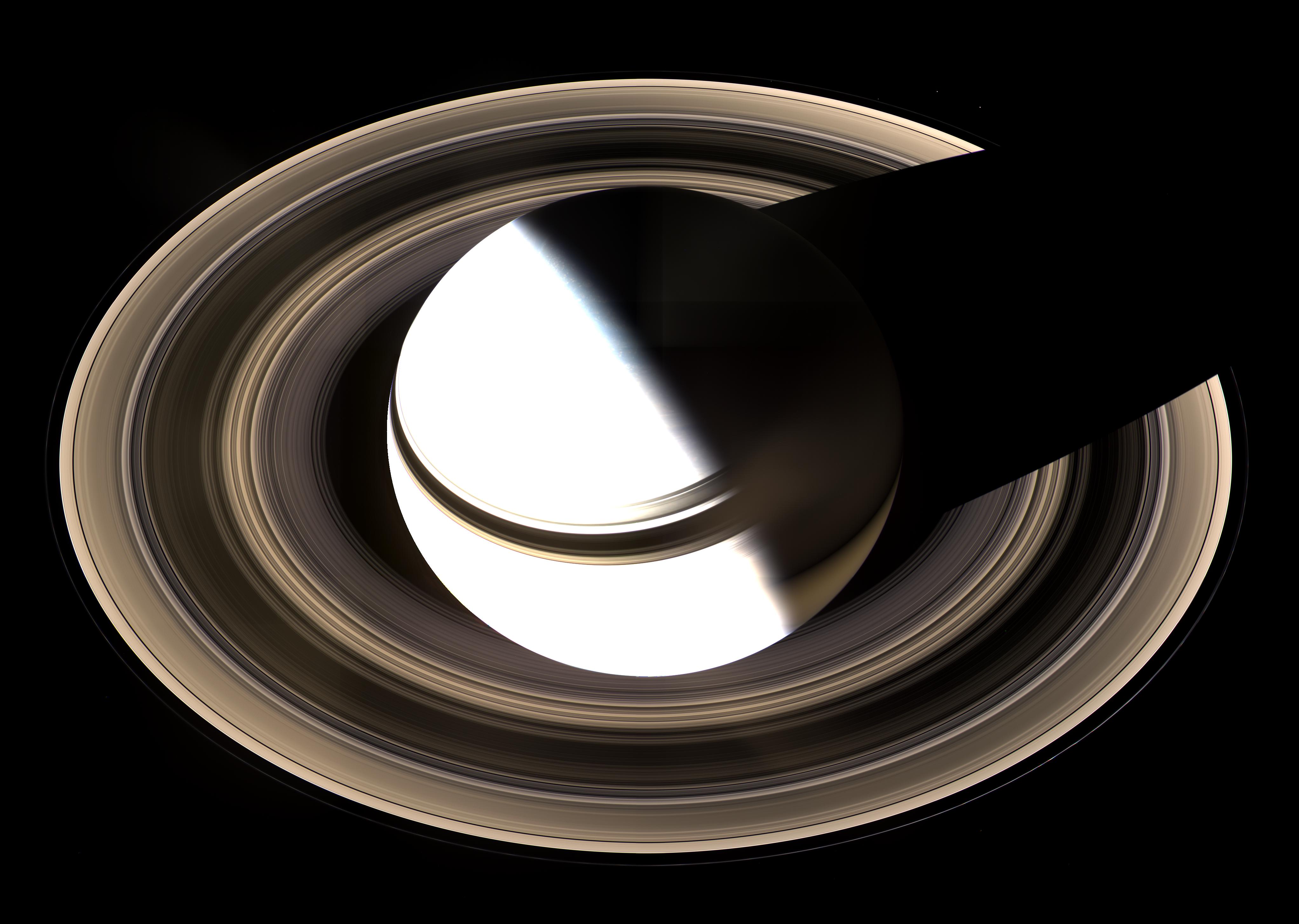
Explanation: This image of Saturn could not have been taken from Earth. No Earth based picture could possibly view the night side of Saturn and the corresponding shadow cast across Saturn's rings. Since Earth is much closer to the Sun than Saturn, only the day side of the planet is visible from the Earth. In fact, this image mosaic was taken in January by the robotic Cassini spacecraft now orbiting Saturn. The beautiful rings of Saturn are seen in full expanse, while cloud details are visible near the night-day terminator divide.
