Nutricia, a Dutch company specializes in dairy products and baby food. To launch their latest ingredient range of Olvarit baby foods, they organized an exclusive tasting-dinner in a Michelin starred restaurant.

Thursday, April 28, 2011

Thursday, April 07, 2011
Honeymoon - Check Natural Disasters- Check
This is not my kind of honeymoon. Before planning your next vacation, check and make sure that these people are staying in Stockholm.
A Swedish couple's honeymoon struck disaster six times - with the couple witnessing floods in Australia, destruction in Japan and the earthquake in Christchurch.
During a four-month trip, newlyweds Stefan and Erika Svanstrom and their baby girl Elinor endured a snowstorm in Munich, Germany, a cyclone that struck Cairns, Australia, the floods of Brisbane, Australia, the wildfires in Perth, Australia, the earthquake that hit Christchurch, New Zealand, and then the earthquake in Japan:
link
A Swedish couple's honeymoon struck disaster six times - with the couple witnessing floods in Australia, destruction in Japan and the earthquake in Christchurch.
During a four-month trip, newlyweds Stefan and Erika Svanstrom and their baby girl Elinor endured a snowstorm in Munich, Germany, a cyclone that struck Cairns, Australia, the floods of Brisbane, Australia, the wildfires in Perth, Australia, the earthquake that hit Christchurch, New Zealand, and then the earthquake in Japan:
The family returned to Stockholm on March 29 after a much calmer visit to their last destination China.
But Mr Svanstrom – who also survived the devastating Boxing Day tsunami that hit southeast Asia in 2004 – said the marriage was still going strong.
He added: “I know marriages have to endure some trials, but I think we have been through most of them.
“We’ve certainly experienced more than our fair share of catastrophes, but the most important thing is that we’re together and happy.
link
Wednesday, March 23, 2011

Tuesday, March 15, 2011
Correct Your Own Posture
This is something that I really should follow up with.
Lane Franklin, LLC has come out with a new posture correction device called PostureNOW. The company says it can permanently correct posture in as little as 10 minutes a day.
When you are seated or standing in the correct position, there is little tension on the elastic bands, but when you slouch, tension on the bands increase to remind you to straighten your posture. PostureNOW is supposed to strengthen your upper back muscles as they straighten in response to the band pressure and then hold the correct position.
The strap-like device, actually a wide tension band, has two neoprene armbands on either side that are attached to the back band with smaller elasticized bands. The whole apparatus slides up your arms like a jacket or coat, when you place one arm in each armband.

For more information or to purchase the PostureNOW, visit Posturenow.com.
link
Lane Franklin, LLC has come out with a new posture correction device called PostureNOW. The company says it can permanently correct posture in as little as 10 minutes a day.
When you are seated or standing in the correct position, there is little tension on the elastic bands, but when you slouch, tension on the bands increase to remind you to straighten your posture. PostureNOW is supposed to strengthen your upper back muscles as they straighten in response to the band pressure and then hold the correct position.
The strap-like device, actually a wide tension band, has two neoprene armbands on either side that are attached to the back band with smaller elasticized bands. The whole apparatus slides up your arms like a jacket or coat, when you place one arm in each armband.
For more information or to purchase the PostureNOW, visit Posturenow.com.
link
Monday, March 07, 2011
The Happiest Man in America
I am shocked that it is not Stuie.
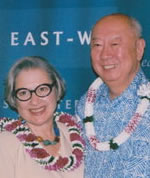 Statistically speaking, anyways.
For the last three years, Gallup has called 1,000 randomly selected American adults each day and asked them about their emotional status, work satisfaction, eating habits, illnesses, stress levels and other indicators of their quality of life.
Statistically speaking, anyways.For the last three years, Gallup has called 1,000 randomly selected American adults each day and asked them about their emotional status, work satisfaction, eating habits, illnesses, stress levels and other indicators of their quality of life.
The New York Times asked Gallup to come up with a statistical composite for the happiest person in America, based on the characteristics that most closely correlated with happiness in 2010. Men, for example, tend to be happier than women, older people are happier than middle-aged people, and so on.Does that person actually exist? The New York Times went a-sleuthin':
Gallup’s answer: he’s a tall, Asian-American, observant Jew who is at least 65 and married, has children, lives in Hawaii, runs his own business and has a household income of more than $120,000 a year.
A few phone calls later and ... Meet Alvin Wong. He is a 5-foot-10, 69-year-old, Chinese-American, Kosher-observing Jew, who’s married with children and lives in Honolulu. He runs his own health care management business and earns more than $120,000 a year.Link
Sunday, March 06, 2011
When Life Gives You Lemons...
Here is a perfect way to take a bad situation add some humor and do something good too.
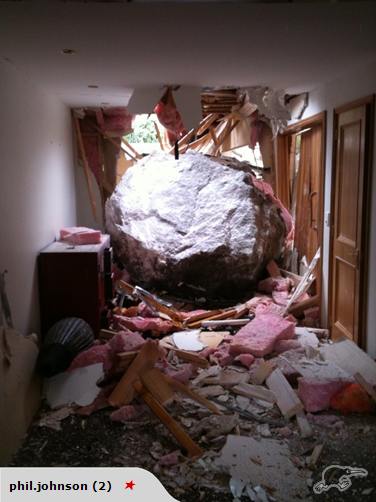
Phil Johnson, a homeowner in New Zealand, has put a rock up for sale. The rock found its way to his home during the recent earthquake in the Christchurch area.
Phil Johnson, a homeowner in New Zealand, has put a rock up for sale. The rock found its way to his home during the recent earthquake in the Christchurch area.
For sale 1 owner 25 – 30 tonne landscape feature (answers to the name Rocky) …
He is in pristine condition (just a little bit of concrete dust). Suitable for garden feature, or as in our case a magnificent addition to your living area.
Rocky will enhance your “indoor outdoor” flow considerably, especially if you load him in through the garage roof like we did.
The Q&A section is priceless! Humor aside, the proceeds from this particular auction go to the Christchurch Earthquake Relief Fund. The current bid is $8,200. Link
Wednesday, February 02, 2011
The Google Art Project
All I can say is wow!

Google Art Project is a collaboration between Google and 17 of the world's top art galleries and museums, including the National Gallery and Tate Britain in the UK, and others including the Museum of Modern Art in New York and the Palace Of Versailles in France.
The Google Art Project website lets users take a trip around the rooms of the galleries using the familiar Street View-style navigation. Virtually move around the museum's galleries, selecting works of art that interest you, navigate though interactive floor plans and learn more about the museum and you explore.
Google Art Project is a collaboration between Google and 17 of the world's top art galleries and museums, including the National Gallery and Tate Britain in the UK, and others including the Museum of Modern Art in New York and the Palace Of Versailles in France.
The Google Art Project website lets users take a trip around the rooms of the galleries using the familiar Street View-style navigation. Virtually move around the museum's galleries, selecting works of art that interest you, navigate though interactive floor plans and learn more about the museum and you explore.
Wednesday, January 26, 2011
Temperature Regulating Slippers

Here's the details on these babies:
These are the slippers made with a patented fabric that regulates the internal temperature to ensure the wearer's feet are always comfortable. Developed for NASA to help astronauts adapt to extreme temperature fluctuations, the fabric absorbs and stores excess body heat to prevent overheating, releasing it back to the skin as the temperature drops to keep feet warm. Also effective when worn to bed, the slippers are insulated with 3 1/2 oz. layer of fine duck down that wicks moisture away, keeping feet dry, unlike synthetic fills that tend to retain humidity. Durable cowskin soles. Machine washable. White. All for $59.95
link
Wednesday, January 19, 2011
Damn Left Hand Turners!
From The Consumerist:
When you think about it, left turns across a lane of traffic are kind of crazy. Only an admixture of luck, skill, and a collective social agreement to, as a general rule, avoid crashing into each other keeps you alive.
In fact, left turns increase the potential for an accident and also waste fuel. So traffic engineers have come up with a new street design, called "superstreets" that get rid of all left turns. And a new study says they are both faster, and safer.
The design uses dividers to force all turns to be right hand turns. Want to go in the opposite direction? Use the U-turns located just down the road from the intersection.
Superstreets have been around since the 60's, first pionerered in Michigan, where they are called "The Michigan Left." Why they are getting attention now is the North Carolina State University study, the first of its kind, finds that superstreets reduce travel time by 20%. See, the U-turns are actually faster because drivers aren't stuck at the light trying to wait for traffic to clear enough to turn. Not only that, but the superstreets studied had 46% fewer reported car collisions and 63% fewer collisions that ended in personal injury.
City planners should take note and think about adding superstreets to their designs.
When you think about it, left turns across a lane of traffic are kind of crazy. Only an admixture of luck, skill, and a collective social agreement to, as a general rule, avoid crashing into each other keeps you alive.

In fact, left turns increase the potential for an accident and also waste fuel. So traffic engineers have come up with a new street design, called "superstreets" that get rid of all left turns. And a new study says they are both faster, and safer.
The design uses dividers to force all turns to be right hand turns. Want to go in the opposite direction? Use the U-turns located just down the road from the intersection.
Superstreets have been around since the 60's, first pionerered in Michigan, where they are called "The Michigan Left." Why they are getting attention now is the North Carolina State University study, the first of its kind, finds that superstreets reduce travel time by 20%. See, the U-turns are actually faster because drivers aren't stuck at the light trying to wait for traffic to clear enough to turn. Not only that, but the superstreets studied had 46% fewer reported car collisions and 63% fewer collisions that ended in personal injury.
City planners should take note and think about adding superstreets to their designs.
Vending Machines That Read Facial Expressions
Both intriguing and scary all at once.
Not only can devices take your temperature with no contact, but now machines can do certain actions by detecting a smile on your face. Unilever has created an ice cream vending machine that will give you a free treat if you smile!
There is now software which enables machines to know exactly how we feel.
link
Not only can devices take your temperature with no contact, but now machines can do certain actions by detecting a smile on your face. Unilever has created an ice cream vending machine that will give you a free treat if you smile!
There is now software which enables machines to know exactly how we feel.
link
Thursday, December 30, 2010

Wednesday, December 22, 2010
A Contender
Here is a contender for the winner of an ugly sweater contest. You too can get it here.
 Is it worth $79? I think not!

Tuesday, December 21, 2010
Color Healing Chart
Guided by the way you feel, you will be able to choose the appropriate colors to help you, as well as select useful crystals. Some of these correspondences may be surprising. Black, for example, often has an undeserved negative association, but it can have quite a different meaning. In many healing traditions such as that of the Native Americans, for example, black is simply seen as the complemenet to white. Observing the night sky, the darkness creates the shadow that lets the light of the stars appear like diamonds on black velvet.
Native Americans teachings revere the darkness as the source of mystery, the place from which all new things are born.
Every creation myth on Earth relates the origin of the planet to a time of dark fromlessness, out of which came light.
Here are some examples of showing how you can use the chart below.
If you feel cold and lacking in energy, you will see that red is a warming color and garnets are suggested. You can either find some red in your wardrobe, or try wearing the crystal or meditating on it.
If you're afraid of change, try wearing or meditating with labradorite. If you want to expand a relationship, wear amber colors or wear the stone.
If you find yourself using a lot of one particular stone or color, then that chakra clearly needs energizing.

Monday, December 20, 2010
Your Apps are Watching
"Your Apps Are Watching You"
Above, the headline of Saturday's Wall Street Journal article by Scott Thurm and Yukari Iwatani Kane, subheaded "A Journal investigation finds that iPhone and Android apps are breaching the privacy of smartphone users."
The graphic accompanied the piece.
A detailed interactive graphic shows the behavior of each of the 101 popular apps investigated by the paper.
Sunday, December 19, 2010
Google 'Reading Level' Search Filter
Google has added a brand new search filter option to the advanced search page named "Reading level."
The purpose is to give users a way to find content based on your reading level. The options include:
- No reading level displayed
- annotate results with reading levels
- show only basic results
- show only intermediate results
- show only advanced results

If you select "annotate results", Google will show you all the search results and add labels to the results with if it is basic, intermediate or advanced. You can also quick filter them on the page.
Another way to look at it is to compare how smart or dumb your site's content is. You can tease your competitors that way. Just do a site:domain.com command with this filter on and presto, you got a great chance of teasing your competitors. Watch out when it is election time and you rate the smart level of politicians.
link
Wednesday, December 01, 2010
The Land of the Unibrow
 L
LIn Tajikistan, the unibrow is commonly thought of as a mark of beauty. Women who don’t have it naturally may resort to herbal remedies in order to grow one:
Usma, a leafy green herb, is sold in all Tajik markets. You can get a small bunch for about $0.06. The process is simple but effective, several market women assured me. Take a bunch of usma and let it dry in the sun for a couple hours. Then grind up the leaves until a dark green goo seeps out. Dip a branch of usma — or a matchstick, if you want to be more precise — into the goo and smear it on your eyebrows, making sure, of course, to color the space in between. Leave on for 15 minutes, and repeat the smearing process one or two more times. The result is a deep black unibrow, rich and expressive.You can view a slideshow of Tajik women with unibrows at the link.
Asking Tajik women why they like the unibrow is a bit like asking Western women why they like to paint their nails or pluck their eyebrows into oblivion.
“I just think it’s beautiful,” was, without exception, the answer I got after asking more than a dozen Tajik women about their unibrows.
Tajikistan is not the only central Asian country where the unibrow reigns supreme — a symbol of feminine beauty and purity. And it’s not as if every Tajik woman has it. The unibrow is the exception, and still found more commonly in places outside the capital.
Link | Photo: Miriam Elder/Global Post
Thursday, November 11, 2010
Monday, November 08, 2010
Thanksgiving Meal in a Cake

Don't want your company to stay too long? Serve them Thanksgiving in a cake and send them on their way.
The entire Thanksgiving meal made to look like dessert. Turkey, cranberry sauce, mashed potatoes, stuffing, mashed potatoes, turkey, sweet potatoes and marshmallows all in one neat package.
Recipe
Saturday, November 06, 2010


Thursday, November 04, 2010
“The harder you work for something, the more you’ll appreciate it.”
Mice Prefer Treats They Worked Harder For

A new study finds that the harder mice have to work for a treat, the better it tastes. The research appears in the Proceedings of the Royal Society. [Alexander Johnson and Michela Gallagher, "Greater effort boosts the affective taste properties of food"]
Mice were trained to push levers to get either of two rewards. Press one lever, out comes a drop of sugar water. Press the other and they get a drop of different tasting sugar water.
Then things got interesting. For one of the treats, scientists gradually increased the amount of effort required for the payoff—from one lever-press to five, then 10, then 15. So by the end of the session, one type of sugar water cost 15 times more effort than the other.
The mice then retired to their home cage where both treats were freely available. And they showed a strong preference for whichever reward they’d worked harder to obtain. Based on how fast the mice sipped, they appeared to find the costlier sugar water more tasty.
Which makes evolutionary sense. An animal wouldn’t survive if a little hard work left a bitter taste in its mouth.
Scientific American

A new study finds that the harder mice have to work for a treat, the better it tastes. The research appears in the Proceedings of the Royal Society. [Alexander Johnson and Michela Gallagher, "Greater effort boosts the affective taste properties of food"]
Mice were trained to push levers to get either of two rewards. Press one lever, out comes a drop of sugar water. Press the other and they get a drop of different tasting sugar water.
Then things got interesting. For one of the treats, scientists gradually increased the amount of effort required for the payoff—from one lever-press to five, then 10, then 15. So by the end of the session, one type of sugar water cost 15 times more effort than the other.
The mice then retired to their home cage where both treats were freely available. And they showed a strong preference for whichever reward they’d worked harder to obtain. Based on how fast the mice sipped, they appeared to find the costlier sugar water more tasty.
Which makes evolutionary sense. An animal wouldn’t survive if a little hard work left a bitter taste in its mouth.
Scientific American
Subscribe to:
Posts (Atom)